

Website Redesign Project Management: The 6-Phase Success Plan
Why Website Redesign Projects Fail Without Proper Management
Website redesign project management is the systematic approach to planning, executing, and controlling a website overhaul. Without it, even well-intentioned redesigns can spiral into costly disasters, which is why 3 out of 4 brands aren’t happy with their site redesign.
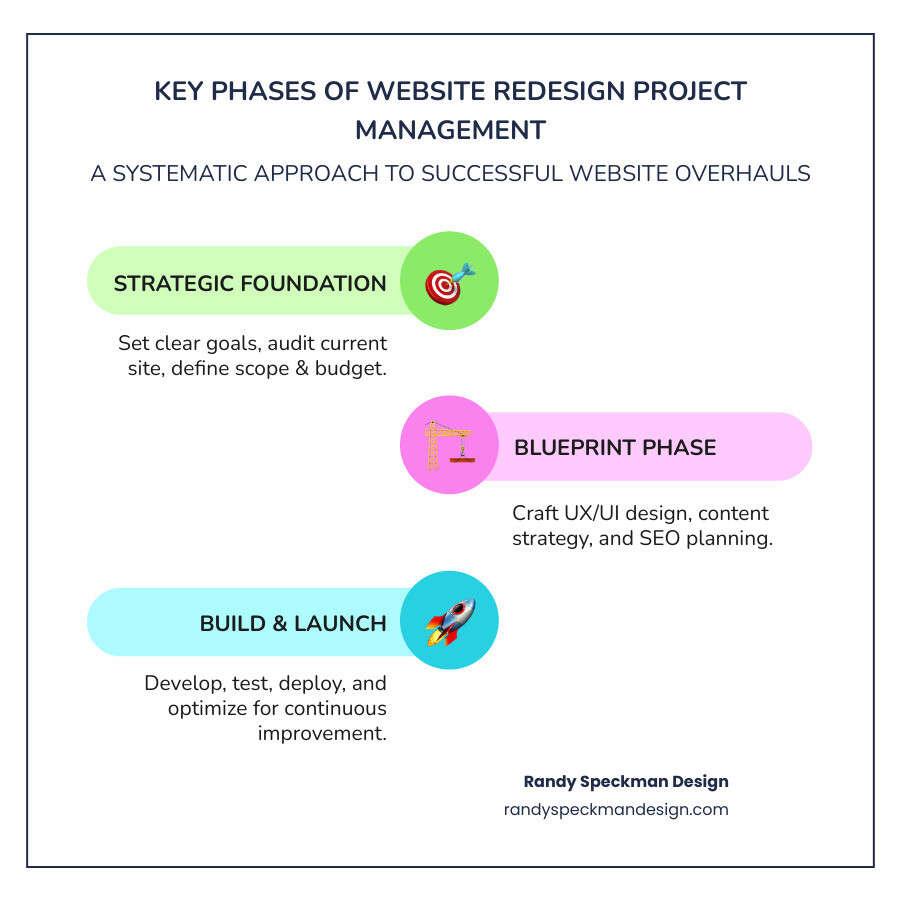
Key phases of effective website redesign project management include:
- Strategic Foundation: Goal setting, auditing, scope, and budget.
- Blueprint Phase: UX/UI design, content strategy, and SEO planning.
- Build & Launch: Development, testing, deployment, and optimization.
With 89% of consumers turning to a competitor after a poor user experience, the stakes are incredibly high. Modern redesigns are complex, involving designers, developers, content creators, and SEO specialists. A single mistake, like a missed redirect or poor mobile optimization, can tank your rankings or alienate half your audience.
However, the payoff for getting it right is huge: every $1 spent on UX design yields $100 back in value—a 9,900% ROI. The key is a systematic approach that keeps everyone aligned.
I’m Randy Speckman, founder of Randy Speckman Design. I’ve guided over 500 entrepreneurs through successful website redesigns using proven website redesign project management methodologies, helping them boost sales while avoiding common pitfalls.
Quick website redesign project management definitions:
Why You Need a Plan & When to Redesign Your Site

Diving into a website redesign without proper website redesign project management is like renovating a kitchen without a blueprint. It’s a primary reason why 74% of brands aren’t satisfied with their redesign results. They skip the planning and jump straight to design, only to see conversion rates and search rankings plummet.
Your website is your 24/7 salesperson and credibility builder. With 89% of consumers turning to a competitor after a poor user experience, there’s no room for guesswork. Most businesses need a complete redesign every 3-5 years to stay competitive, especially with constant technology shifts like Google’s move to mobile-first indexing.
Key Indicators It’s Time for a Website Redesign
Look for these warning signs:
- Declining Traffic & Leads: Your stream of visitors and potential customers is drying up.
- Outdated Design: Your site looks old-fashioned, is hard to steer, and provides a poor user experience.
- Not Mobile-Friendly: Your site is unusable for the 50%+ of users on mobile devices. 67% of users are more likely to buy from a mobile-friendly site.
- Slow Page Speed: 53% of people abandon mobile sites that take longer than 3 seconds to load. Learn more about Why Website Speed Matters and How to Improve It.
- Difficult to Update: Your content management system is working against you, making simple updates a chore.
- Poor User Feedback: Users consistently complain about confusing layouts or navigation.
The Essential Role of a Project Manager
A redesign project can’t manage itself. A skilled project manager is the central hub, ensuring the project stays on track. Their key responsibilities include:
- Central Point of Contact: Translates between the marketing team’s vision, developers’ technical constraints, and leadership’s budget concerns.
- Stakeholder Management: Gathers requirements from all departments (sales, marketing, IT) and finds compromises to keep everyone aligned.
- Budget and Timeline Control: Knows that custom projects typically take 3-4 months and builds realistic schedules with buffers for unexpected requests.
- Risk Mitigation: Spots potential problems—like content delays or complex integrations—before they derail the launch.
- Team Coordination: Ensures the designer, developer, SEO specialist, and content writer are all working in sync. As The Project Manager Leads the Way, they conduct the entire effort.
- Quality Assurance: Oversees testing across browsers and devices to ensure the final product is flawless and achieves business goals.
Without proper website redesign project management, you risk your time, money, and digital future. With the right plan, your redesign can be the growth catalyst your business needs.
Phase 1: Strategic Foundation & Planning

The strategic foundation is the most critical phase of website redesign project management. It’s where we define success, outline the path to get there, and assemble the team. Skipping this step is like setting sail without a compass.
Auditing Your Current Website & Setting Benchmarks
First, we perform a digital health check-up on your existing site to understand what’s working and what isn’t.
- Analytics Review: We dive into your Google Analytics data to analyze traffic, user behavior, bounce rates, and conversions. This establishes baseline metrics. For a deeper look, consider our Website SEO Audit Services.
- Content & Usability Audit: We inventory your content for relevance and performance, identifying what to keep, update, or remove. We also conduct user testing and heuristic evaluations to find usability issues.
- Benchmarking KPIs: We establish clear Key Performance Indicators (KPIs) like organic traffic goals, conversion rate targets, and bounce rate reductions to measure the redesign’s success.
Estimating Scope, Timeline, and Cost
With a robust website redesign project management approach, we can accurately define the project’s parameters.
- Scope & Deliverables: We define the specific pages, features, and functionalities required, triaging them into “must-haves” and “nice-to-haves” to manage scope and budget.
- Timeline & Cost: A custom website design typically takes 3-4 months and can require a budget of $60,000 or more for satisfactory results that include strategy, content, and SEO. We plan for content creation needs early, as this is often a bottleneck, and build in contingency time for unexpected delays. For help choosing a partner, see our guide on How to Choose a Web Design Company.
Assembling Your Project Team & Tools
A successful redesign requires a dedicated team and the right tools to keep everyone aligned.
- Defining Roles: A quality website requires a Project Manager, Web Strategist, UI/UX Designer, Web Developer, SEO Specialist, and Content Writer. Our team at Randy Speckman Design brings these experts together.
- Project Management Tools: We use tools like Jira or Asana to assign tasks, track progress, and centralize communication.
- Communication Plan: We establish regular check-ins and clear communication channels to ensure all stakeholders receive updates on progress and potential issues. Our Onboarding Process ensures we start with full alignment.
Phase 2: The Blueprint – Design, Content & SEO

This phase is like creating the architectural blueprint for your new digital home. With the strategic foundation set, we translate goals into a tangible design that users can click, tap, and engage with. This is where website redesign project management moves from spreadsheets to the creative process.
Crafting the User Experience (UX) and UI Design
Great design is invisible; it helps users find what they need effortlessly. Our approach to Creating User-Centered Designs involves:
- Buyer Personas & User Journeys: We create detailed profiles of your ideal customers and map their path through your site to anticipate their needs and questions.
- Wireframing & Prototyping: We build a structural skeleton (wireframe) of your site, focusing on layout and functionality. Then, we create a clickable prototype so you can test drive the site before any code is written.
- Visual Design: We select colors, typography, and imagery that reflect your brand and guide users toward action. The right visuals are critical, as the wrong font can kill your conversion rate. Every element is optimized for Conversion Rate Optimization.
Developing a Content & SEO-Focused Website Redesign Marketing Strategy
Great content and smart strategy must work together. We build websites where SEO Meets Web Design: Crafting Sites That Rank and Rock.
- Content Strategy: We perform a content inventory and gap analysis to see what to keep, refresh, or create. We establish a content creation workflow to ensure copy is ready before design is finalized.
- On-Page SEO & Keyword Mapping: We optimize titles, meta descriptions, and headers. We research the terms your customers use and map them to specific pages to attract the right audience.
- URL & Linking Structure: We plan clean, descriptive URLs and a logical internal linking strategy to help both users and search engines steer your site and understand its structure.
Protecting Your SEO Rankings During the Redesign
A poorly managed redesign can destroy years of SEO progress. Our process includes bulletproof SEO protection.
- URL Mapping & 301 Redirects: This is non-negotiable. We map every old URL to its new one and implement 301 redirects to tell search engines where the page has permanently moved, preserving its ranking power.
- Preserving High-Value Pages: We take special care of your top-ranking pages that drive traffic and leads.
- Technical SEO: We avoid keyword cannibalization (multiple pages competing for the same term) and create a new XML sitemap to help search engines index your new site quickly. Our Site Migration process ensures your rankings survive the transition.
Phase 3: The Build, Launch & Beyond

This is where your vision becomes a reality. The build phase turns your approved designs into a living, breathing website that performs flawlessly for every visitor. Expert website redesign project management is critical to ensure the final product works across all browsers and devices.
Development, Testing, and Quality Assurance
Our development process begins by choosing the right foundation, typically a content management system (CMS). We specialize in custom WordPress websites custom to your needs. You can learn more about Website Content Management Systems in our guide.
Our developers build both the front-end (what users see) and the back-end (the behind-the-scenes functionality). Rigorous testing is key:
- Cross-Browser & Mobile Testing: We use tools like BrowserStack to ensure your site looks and functions perfectly on all major browsers and mobile devices. This is crucial, as 67% of users are more likely to buy from a mobile-optimized site.
- Usability & Performance Testing: We test with real users to identify confusing navigation and conduct performance checks to ensure fast load times.
The Ultimate Website Launch Checklist
Launch day is exciting but requires a meticulous checklist. We schedule launches for non-peak times to minimize impact.
- Final Checks: We migrate all final content, implement the critical 301 redirects, and ensure all analytics and tracking codes are installed and firing correctly.
- Functionality Tests: Every form is tested to prevent lost leads, and we run a comprehensive broken link check.
- Go-Live Steps: We submit your new XML sitemap to Google Search Console, create a complete backup of the site, and clear all caches to view the live version.
Post-Launch Strategy and Ongoing Optimization
Launch day isn’t the finish line; it’s the starting gun. A website’s real journey begins once users start interacting with it. We believe web design is a process, not a project.
- Monitoring & Tracking: We constantly monitor analytics and keyword rankings to see how the new site is performing and identify any issues.
- Gathering Feedback & A/B Testing: We gather user feedback and use A/B testing on headlines, buttons, and layouts to continuously improve performance.
- Ongoing Maintenance: We keep your site fresh with regular content updates (2-3 blog posts per week is ideal), perform security monitoring, and optimize performance to protect your investment. You can see our clients’ long-term success in Our Projects.
The most successful websites evolve. Your launch is just the beginning of a journey toward higher conversions and stronger business results.
Common Mistakes to Avoid in Website Redesign Project Management
Even with a solid plan, website redesign project management can go sideways. Most disasters are preventable if you know what to look for. Here are the biggest mistakes to avoid:
- Treating SEO as an afterthought: This is the most expensive mistake. Failing to plan for redirects and content migration can cause you to lose 50% of your organic traffic overnight. SEO must be integrated from day one.
- Having vague goals: “We want a better website” is a wish, not a goal. You need specific, measurable objectives (e.g., “increase lead generation by 40%”) to know if the redesign was a success.
- Underestimating the content effort: Content is almost always the bottleneck. Writing, editing, and optimizing compelling copy takes significant time and effort. Plan for it upfront.
- Designing for the boardroom, not customers: Your CEO has opinions, but your website is a tool for your customers. With 89% of consumers leaving after a poor UX, user needs must come first.
- Skipping thorough testing: Launching with broken forms, poor mobile layouts, or slow pages is a recipe for failure. Cross-browser, mobile, and performance testing are essential.
- Poor communication: When the team isn’t aligned, you get a confused website. Establish clear communication channels and regular check-ins to keep everyone on the same page.
- Allowing scope creep: Small additions like “Can we just add a blog?” can quickly derail your timeline and double your budget. A strong project manager prevents this.
- Forgetting post-launch maintenance: A website is not a “set it and forget it” investment. It needs ongoing security, content, and performance updates to remain competitive. Budget for this from the start.
Successful projects anticipate these challenges. Proper planning is the difference between a smooth renovation and a construction nightmare.
Conclusion
Your website redesign doesn’t have to be a nightmare. With proper website redesign project management, an overwhelming ordeal becomes a powerful opportunity to grow your business. You now have a clear roadmap covering the strategic foundation, the design blueprint, and the build and launch phases.
The statistics are clear: every $1 spent on UX design can yield $100 back in value. This 9,900% ROI is achievable, but only with a strategic approach. A redesign shouldn’t just give you a prettier website; it should deliver a business growth engine that converts visitors into customers.
At Randy Speckman Design, we’ve guided over 500 entrepreneurs through successful redesigns using these proven methods. Based in Kennewick, WA, we help businesses everywhere transform their digital presence. Our expertise in marketing, digital strategy, and conversion optimization means we build websites that perform.
The key is a partner who understands that web design is a process, not a project—one who protects your SEO rankings and stays committed to your success long after launch.
Ready to transform your website into a powerful business tool? Explore our Website Redesign Services to ensure your next project is a success. Let’s build something amazing together.