
Website Redesign Case Studies: 3 Magic Results
Why Website Redesign Case Studies Matter for Your Business Growth
Website redesign case studies reveal the transformative power of strategic web design changes that go far beyond aesthetics. These real-world examples demonstrate how businesses achieve measurable growth through thoughtful redesigns.
Top Website Redesign Case Study Results:
- HubSpot: Doubled conversion rates through strategic redesign
- Power Factors: 170% increase in organic sessions, 252% boost in user engagement
- Snowflake University: 900% increase in organic traffic
- BC Burn Fund: +17% donation rate improvement
- RTS Cutting Tools: 470% conversion rate increase
- Knockout Pest Control: 308% web traffic growth over two years
The most successful redesigns address core business challenges like poor user experience, outdated branding, slow page speeds, and low conversion rates. They combine strategic planning with user-centered design to create websites that drive business results.
Whether you’re struggling with high bounce rates or a website that doesn’t reflect your brand’s evolution, these case studies provide a roadmap for change. The data shows that strategic redesigns consistently deliver significant returns on investment.
I’m Randy Speckman, founder of Randy Speckman Design. I’ve helped over 500 entrepreneurs design websites that drive strategic growth by analyzing countless website redesign case studies and implementing proven strategies to achieve measurable results like reduced production costs and increased customer retention.
Website redesign case studies word guide:
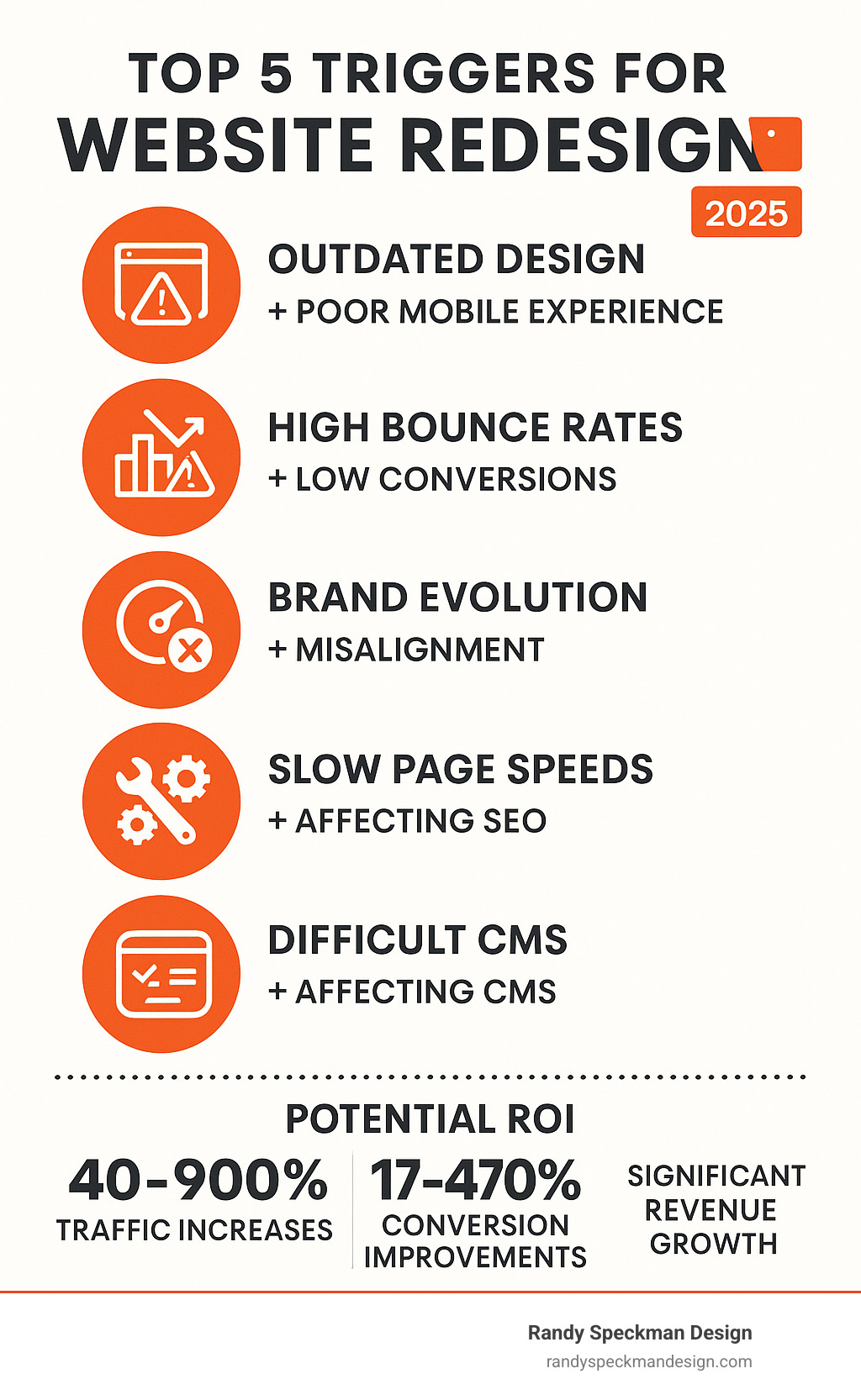
Common Triggers: When Do You Know It’s Time for a Redesign?

Many businesses find their online presence becoming outdated, which affects functionality, performance, and business goals. Let’s explore the common triggers and problems that signal it’s time for a website redesign.
One of the most obvious signs is an outdated design and poor user experience (UX). If your website has clunky navigation, tiny text, and a layout that isn’t responsive, you’re likely frustrating visitors. This often leads to a high bounce rate, as people leave your site quickly when the experience is unpleasant.
Another critical trigger is brand misalignment. As your business evolves, your brand identity should too. If your website no longer reflects your current brand values, messaging, or offerings, it creates a disconnect. This can happen after rebranding, mergers, or simply outgrowing your initial startup site.
Technical issues also play a huge role. Is your site not mobile-friendly? A non-responsive website is a deal-breaker in today’s mobile-first world. Our expertise in Responsive Website Design ensures your site functions perfectly on any device. Furthermore, slow page speed is a notorious culprit for poor UX and SEO. Visitors expect fast loading, and search engines penalize slow sites. If your website takes too long to load, it’s screaming for an overhaul. You can learn more in our article, Why Website Speed Matters And How To Improve It.
Finally, difficult content management and low conversion rates are major red flags. If updating your website is a chore, or if your site isn’t generating the leads and sales you need, it’s a bottleneck. Websites should be dynamic products that support growth. When your current CMS and architecture are holding you back, it’s a clear signal: it’s time for a strategic website redesign.
Inspiring Website Redesign Case Studies with Proven ROI
At Randy Speckman Design, we know a website redesign is about tangible results. Smart improvements lead to incredible increases in traffic, conversions, and engagement. Let’s explore some inspiring website redesign case studies that prove the amazing outcomes companies can achieve. You can also explore more examples in our Portfolio.
Case Study 1: Boosting Conversions and Sales (E-commerce & B2C)
E-commerce and B2C website redesign case studies are compelling because they directly impact the bottom line.
Take the famous HubSpot redesign. They didn’t just tweak colors; their strategic overhaul doubled their conversion rates. This proves that designing with user-focused purpose drives business growth.
The redesign for Jonkers Rare Books modernized their e-commerce presence. Inspired by high-end brands, the new design used refined fonts and clean product photos to improve the user experience for their niche market. This case shows how a refined look and clear organization can vastly improve the user experience. You can see their new site at the Jonkers website.
In the service world, Knockout Pest Control saw a 308% increase in web traffic over two years. Their redesign transformed a basic site into an educational resource with helpful content and seasonal navigation. This content hub strategy significantly boosted their online presence.
Even B2B companies see dramatic results. RTS Cutting Tools achieved a phenomenal 470% conversion increase. Their 17-year-old site was redesigned with a focus on responsive design, built-in SEO, and a paid search program. A key strategy was de-optimizing for low-quality keywords to attract better leads, showing how a redesign with a smart digital strategy can drive revenue. We often help clients find similar opportunities to improve their Conversion Rate Optimization Case Studies, much like the success we saw with Project: AE Design Build.
Case Study 2: Driving Growth for B2B Tech Companies
B2B tech companies have complex products and diverse audiences, needing scalable platforms. Website redesign case studies in this sector show how web development becomes a growth engine.
Power Factors saw remarkable gains, boosting organic sessions by 170% and user engagement by 252%. They unified acquired brands under one conversion-optimized website with a clear message and design.
Snowflake University’s microsite redesign is another standout, leading to a 900% increase in organic traffic. The project consolidated a messy educational platform into a single, user-friendly experience, showing how a focused redesign on a microsite can yield huge returns.
In the Web3 world, Solana’s website redesign resulted in a 30% decrease in content publishing time and a 90% reduction in developer reliance. They used modular design systems and a flexible architecture, empowering their marketing team to make updates easily, reducing bottlenecks and increasing agility. Similarly, Knapsack saw 30% faster load times after their redesign, improving user experience and search engine rankings.
These examples show a successful B2B tech redesign requires strategic alignment, flexible systems, top performance, and integrated content and SEO from the start. Our SEO Optimized Website Design services are built on these principles, ensuring our clients’ websites are powerful growth machines.
Case Study 3: Revitalizing Non-Profit and Mission-Driven Websites
Non-profits rely on their websites for awareness, fundraising, and volunteer recruitment. Website redesign case studies in this sector show how an improved online presence helps them achieve their missions.
The BC Burn Fund saw a significant +17% Donation Rate after their website redesign. This shows how an updated, user-friendly site simplifies contributions, helping the organization meet its goals.
Food Runners redesigned their site to increase individual engagement, as their old site focused on businesses. Through user research, they finded they needed to directly ask individuals to participate. The redesign focused on clear invitations and building trust, addressing research from Stanford that suggests people often don’t volunteer simply because they aren’t asked.
The Green Chair Recycling UX case study involved redesigning a site built on a free WordPress template. The process included competitive analysis, IA audits, and card sorting to reorganize content. The project highlighted the importance of user surveys to avoid personal bias (“you are not the user!”) and serve diverse audiences, noting that elements like image carousels are often ignored, according to NNGroup research. Our work on Project: Genesis Family Law often involves similar deep dives into user needs.
These cases show that for non-profits, a redesign is about connecting with audiences, building trust, and simplifying engagement and support.
The Blueprint for Success: Key Steps in a Website Redesign Project

Successful website redesign case studies reveal a common thread: a proven, strategic process. Rather than jumping to design, a methodical, data-driven approach aligned with business goals is key.
At Randy Speckman Design, our four-phase, iterative process is the same blueprint behind major successes like Power Factors’ 170% organic session increase. It ensures your redesign is a growth engine, not just a digital facelift. Learn more about our approach through our Website Redesign services.
Phase 1: Strategy and Research
This foundational phase is about understanding your business. We start with a comprehensive website audit, analyzing technical performance and user navigation to uncover hidden issues costing you customers.
Our competitor analysis goes beyond aesthetics to identify industry trends, market gaps, and opportunities for you to stand out.
Defining goals and KPIs is crucial. We establish concrete targets, like increasing lead generation by 50%, to guide the project.
We also create detailed user personas based on real data about your visitors’ needs and behaviors. Finally, we design the information architecture, the blueprint for your content organization. Good IA makes navigation feel intuitive. Our Website Redesign Marketing Strategy approach ensures this foundation supports your business objectives.
Phase 2: Design and User Experience (UX)
This is where strategy meets creativity. We craft experiences that guide users toward your goals.
Wireframing creates the website’s skeleton, showing structure and layout. This allows us to focus on functionality and user flow before visual design.
From there, prototyping creates an interactive model of your site. This allows for user testing and feedback before development, saving time and money.
In the UI design phase, we select colors, fonts, and imagery that reflect your brand and serve a purpose, guiding users and reinforcing your message.
We always take a mobile-first approach, which prioritizes essential elements and improves the desktop version as well. We also bake in accessibility from the start, ensuring your site works for everyone.
Our comprehensive style guides document every visual element, ensuring consistency and simplifying future updates. Check out our 10 Tips For Improving Your Websites User Experience for more insights.
Phase 3: Development and SEO Implementation
This phase transforms designs into a functional website, focusing on performance, speed, and SEO.
CMS selection is crucial. We help you choose between platforms like WordPress or custom solutions based on your needs. Factors like e-commerce functionality and team size influence our recommendation. Explore this in our guide on The Benefits Of Custom Website Design Vs Website Templates.
Our custom development approach ensures your site is built with clean, efficient code. We build a custom digital experience custom to your needs.
A critical 301 redirect strategy is essential. We map old URLs to new ones to preserve your SEO value and prevent “page not found” errors.
On-page SEO is woven into development. We optimize tags, headings, and alt text with relevant keywords, ensuring content sounds natural.
Performance optimization is key. We compress images, minify code, and implement caching to ensure your site loads lightning-fast, as slow sites frustrate users and are penalized by search engines. Our Web Design Optimization Techniques ensure peak performance.
Phase 4: Launch and Post-Launch Analysis
The launch is just the beginning. This phase focuses on ensuring functionality and using real user data for continuous improvement.
Before going live, we conduct thorough usability testing. Watching real users interact with the site reveals invaluable insights into usability.
Once launched, A/B testing becomes your secret weapon. We test different headlines, buttons, or layouts to see what drives better results. Small changes can have a big impact on conversions.
Performance monitoring means tracking everything from page load speeds to user behavior, looking for opportunities to optimize.
Regular analytics review helps us understand what’s working. This data on user behavior and conversion effectiveness drives our recommendations for ongoing improvements.
Successful website redesign case studies treat the website as a living asset that evolves with the business. Through continuous improvement and our focus on Conversion Rate Optimization, we ensure your investment keeps paying dividends.
This data-driven, phased approach separates successful redesigns from costly mistakes, creating a website that drives real business results.
Frequently Asked Questions about Website Redesign Case Studies
Let’s explore common questions about website redesign, backed by insights from real-world website redesign case studies.
What problems can a website redesign solve?
A website redesign is a strategic move that solves major online business challenges. It can fix a poor user experience (UX), changing a clunky, confusing site into one that’s a joy to use. It can improve low organic traffic by integrating SEO best practices and lower high bounce rates with a fresh design and faster loading.
A redesign also addresses outdated branding, ensuring your site reflects your current business identity. It solves slow page speed, which hurts both UX and SEO, and can fix low conversion rates by streamlining the user journey to encourage action. Finally, it can resolve issues with difficult content updates and a site that’s misaligned with business goals by providing a modern, manageable platform.
How do you measure the success of website redesign case studies?
Success is measured by tangible results, focusing on Key Performance Indicators (KPIs). We look for organic traffic growth; for example, Snowflake University’s 900% increase is a clear win. We also scrutinize the conversion rate increase. This metric is crucial. HubSpot doubled their conversions, and RTS Cutting Tools saw a 470% increase—both are measurable returns.
Other crucial metrics include raw numbers for lead generation, direct impact on sales revenue, a lower bounce rate, and improved keyword rankings. We also track faster page load times, like Knapsack’s 30% improvement, which boosts UX and SEO. Finally, we measure increased user engagement (time on site, pages per visit) and operational efficiencies, like Solana’s 90% reduction in developer reliance.
What are the key lessons from these website redesign case studies?
Analyzing website redesign case studies reveals several foundational principles for success.
First, a user-centric approach is paramount. As the Green Chair Recycling case study showed, “you are not the user.” User research, personas, and usability testing are non-negotiable.
Second, data-driven decisions rule. Rely on analytics, competitor analysis, and user feedback to guide every decision, removing guesswork.
Another critical lesson is that SEO integration from day one is a game-changer. SEO must be integrated from the start—from keyword research and technical setup (like 301 redirects) to content strategy—to ensure your new site gets found.
Furthermore, clear goals drive success. Clear objectives, like boosting donations for BC Burn Fund or reducing developer reliance for Solana, provide a roadmap and measure of success.
It’s also undeniable that mobile-first design is essential. With most users on mobile, a flawless mobile experience is no longer optional. And finally, the importance of a strong CMS cannot be overstated. A robust CMS empowers you to keep your site fresh and scalable.
These website redesign case studies show a redesign is a strategic investment that delivers measurable ROI, becoming a powerful growth engine.
Conclusion: Turn Your Website Into Your Most Powerful Growth Engine
The website redesign case studies we’ve explored prove that strategic redesigns deliver extraordinary results. From HubSpot doubling conversions to Snowflake University’s 900% traffic increase, these examples show your website can be your most powerful business asset.
The success isn’t just visual; it’s about solving real business problems and driving measurable growth. Cases like BC Burn Fund’s 17% donation increase or RTS Cutting Tools’ 470% conversion boost prove a well-executed redesign is a strategic investment.
At Randy Speckman Design in Kennewick, WA, we’ve seen this firsthand. Our expertise in marketing strategy and conversion optimization means we engineer digital experiences that support your business goals, not just look pretty.
Our approach combines lessons from these website redesign case studies with proven methods. We use research, strategy, and user-centered design to convert visitors, integrating SEO and performance optimization from day one for long-term growth.
The evidence is clear: strategic redesigns dramatically improve traffic, conversions, and revenue. Your current website could be holding you back. The question isn’t if you can afford to redesign, but if you can afford not to.
Ready to transform your website into a growth engine that delivers results like the case studies we’ve explored? Let’s turn your digital presence into your competitive advantage.